A roof problem does not always announce itself with water dripping through the ceiling. More often, it starts with a small detail: a tile that has moved, moss collecting in one area, a gutter that overflows every time it rains, or a damp mark appearing indoors after bad weather.
The difficulty for homeowners is that roofs are not easy—or safe—to inspect closely. That is why it helps to know the common warning signs and what they may mean. Not every issue requires a new roof, but an early inspection can make it easier to understand whether you need a roof repair, maintenance or simply something to keep an eye on.
Here are five signs your roof may need attention.
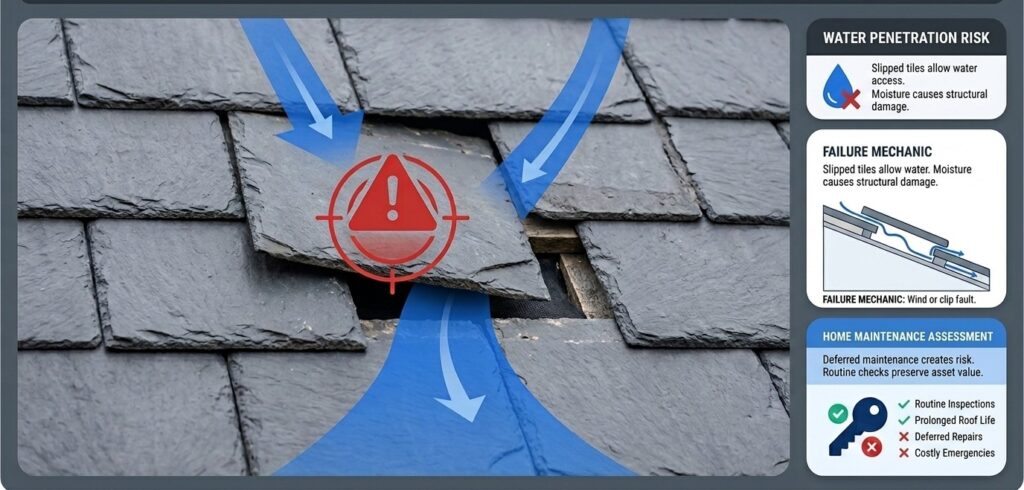
1. Missing, slipped or broken tiles
Tiles and slates protect the layers beneath them from rain and wind. If one has slipped, cracked or gone missing, water can potentially reach the felt, battens or roof structure beneath.
Visit: Tile & Slate Roof Repairs Service Page
You may spot a tile on the ground after high winds, see an uneven line on the roof from a safe distance, or notice a different-coloured patch where a tile is missing. Do not climb up to investigate. Take a clear photograph from ground level if safe, and arrange a professional assessment.
A single displaced tile is not automatically a sign that the whole roof needs replacing. However, it is worth checking why it moved. The surrounding tiles, fixings, ridge and roofline may also need attention.
2. Water marks, damp patches or a musty smell indoors
A ceiling stain does not always mean the water is entering directly above it. Rain can travel along timbers, felt or other surfaces before becoming visible inside. That means the source may be some distance from the mark you can see.
Look out for:
- Brown or yellow marks on ceilings or walls
- Peeling paint near the top of a room
- Damp insulation in the loft
- A musty smell after heavy rain
- Light visible through the roof covering from inside the loft
If you see a sagging ceiling, water close to electrics, or active water entering the property, treat it as urgent and seek help promptly. Avoid touching wet electrical fittings.
Visit: Emergency Roof Repairs Service Page
Government housing research shows that homes with roof disrepair are more likely to report moisture damage following storms, which reinforces the value of addressing known defects before severe weather arrives.
Link: English Housing Survey: weather-resilient homes
3. Moss, debris or blocked roof drainage
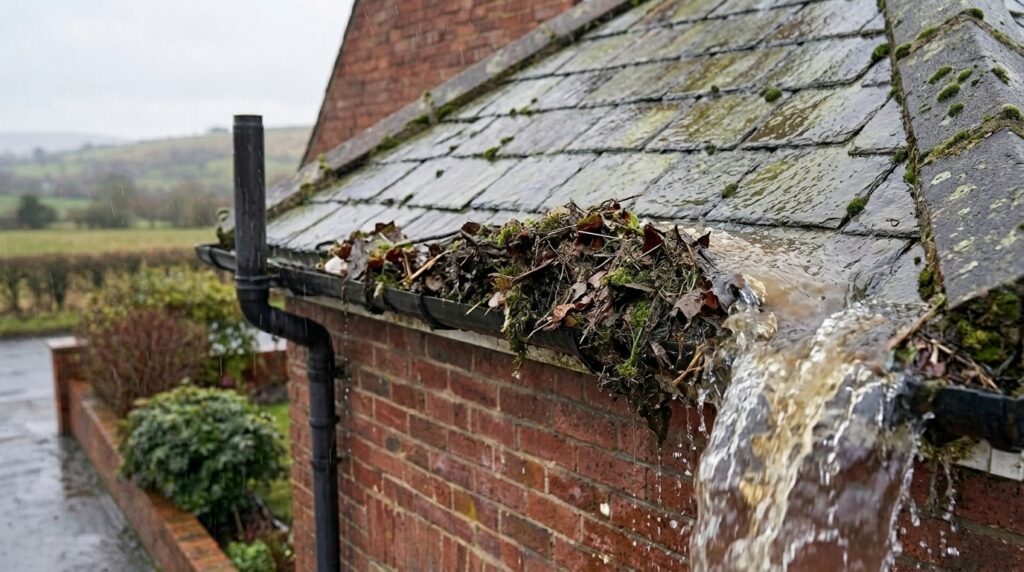
Moss is often treated as a purely cosmetic issue, but it can hold moisture and trap leaves or debris around tiles, valleys and gutters. On its own, moss does not prove that a roof is failing. The concern is whether it is contributing to blocked drainage, lifting tile edges, moisture retention or neglected maintenance.
Gutters matter too. If water is overflowing during rain, the cause could be leaves, moss, a blockage, poor alignment or a downpipe issue. Water that repeatedly spills onto walls and around the base of a home can create problems beyond the roof itself.
Visit: Gutter Repairs & Maintenance Service Page
A professional assessment should consider the whole water-management route: roof covering, valleys, flashing, gutters, downpipes and where the water is directed once it leaves the property.
4. Damaged flashing, mortar or chimney details
Flashing is the weatherproof material used where a roof meets a chimney, wall, roof window or other junction. These areas are common points for water entry because they deal with movement, rain and changes in temperature.
From ground level, you may notice loose-looking flashing, deteriorating mortar, an uneven ridge line or vegetation around a chimney. Internally, you may see damp patches near a chimney breast.
Do not assume that a visible crack means a major job. Equally, do not ignore it because it appears small. The right approach is to inspect the surrounding detail, identify the source of the problem and explain the repair scope clearly.
5. A roof that looks uneven, tired or visibly sagging
An uneven roofline, sagging area or noticeable dip deserves prompt professional attention. It does not tell you the exact cause from the ground, but it may indicate an issue with the roof structure, covering, water damage or previous work.
This is different from normal ageing. Older roofs often show weathering, colour variation and surface wear without being unsafe. The key question is whether the roof is still performing as it should.
What should you do next?
tart with a safe visual check from ground level. Make a note of when you first noticed the issue and whether it appears after rain or wind. Take photographs if safe. Then ask for a clear inspection and written explanation of what has been found.
When comparing quotes, make sure they state what is included, what materials are proposed, whether access or scaffolding is required, and what happens if additional defects are discovered. Citizens Advice recommends getting written quotes and comparing the scope, not simply choosing the lowest figure.
Link: Citizens Advice: getting work done on your home
When comparing quotes, make sure they state what is included, what materials are proposed, whether access or scaffolding is required, and what happens if additional defects are discovered. Citizens Advice recommends getting written quotes and comparing the scope, not simply choosing the lowest figure.